Column → row
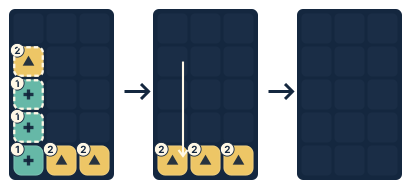
Two of a color on a row with one gap, and the same color exactly three rows above the gap. When the three between clear in a column, that color falls and makes a row of three.
 RENSA
alpha
日本語
A chain repeats three steps: cells clear, the cells above fall, and colors line up again. Count which columns fall and by how much, and you can see where the next line will form.
This page shows how to count it, the nine basic two-chain shapes to learn first, and forms built in three columns. Every diagram comes from the same rules the game uses.
The next line forms from colors that stayed and colors that fell. For example, when two cells of a color sit side by side and the same color waits exactly three rows or one row above the gap, that is a likely next line.
The first line to clear is a column, a row or a diagonal, and so is the next line, so a two-chain comes in nine basic shapes. After a column clears, the cells above fall three rows; after a row or a diagonal, one row. By that fall, the nine shapes make four ways one clear leads to the next.
| First \ next | Column | Row | Diagonal |
|---|---|---|---|
| Column | falls 3 | falls 3 | falls 3 |
| Row | falls 1 | falls 1 | falls 1 |
| Diagonal | falls 1 | falls 1 | falls 1 |
Each diagram reads left to right: the last piece placed (dashed cells), the fall after the first chain (arrows), and what is left. The number on a cell is the chain it clears in. Each one is the example with the fewest blocks the search found.
Two of a color on a row with one gap, and the same color exactly three rows above the gap. When the three between clear in a column, that color falls and makes a row of three.
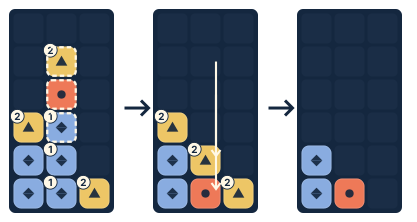
Two of a color on a diagonal with one gap, and the same color exactly three rows above the gap. When the three between clear in a column, that color falls and completes the diagonal.
Try it in RENSA Puzzles: Stack to clear, and let the piece fall
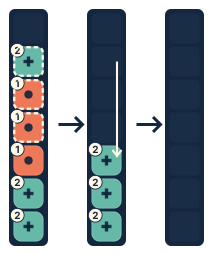
One column holds, from the bottom, two of a color, three of another, and one of the first. When the middle three clear, the top one falls onto the two.
Try it in RENSA Puzzles: Link vertical clears to a diagonal and a row
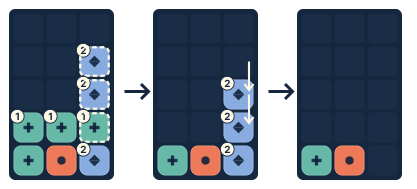
In one column, a color sits on both sides of one cell of another color. When that cell clears in a row, the cells above fall one row and three stand in a column.
Try it in RENSA Puzzles: Use the heights to make five chains
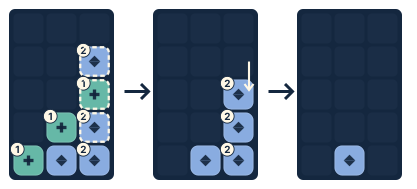
Two of a color, one cell of another on them, and the first color again on top. When the cell between clears in a diagonal, the top one falls and three stand in a column.
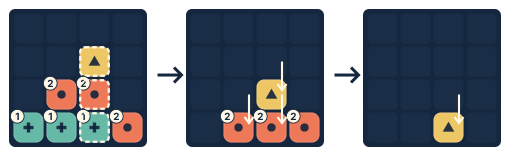
Two of a color above a row that clears, and one more at the row's height in the next column off the row. The two fall one row and line up with it.
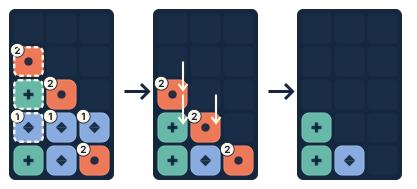
Two of a color above a row that clears, and one below the row. The two fall one row and make a diagonal with it.
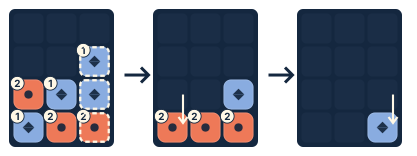
Two of a color side by side below a diagonal that clears. The same color above the diagonal falls one row and makes the row.
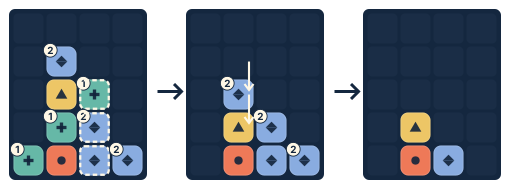
One of a color above a diagonal that clears, and two of it where nothing moves (below the line or in a column it does not cross), on the diagonal the other way. The one above falls one row and completes it.
In every shape, the next line is made of colors that fell and colors that stayed.
Besides these, a ✕ block peels when a neighbor clears and shows the color inside, which can line up without falling. When two lines clear at once, some columns fall two rows.
These forms use three columns only. In every one, each column clears vertically once, and every other clear is a row or a diagonal. All three columns are as tall as the chain is long, and nothing is left at the end.
A column's height is the number of row or diagonal clears plus three times its own column clears: a column clear takes three cells from one column, and a row or diagonal one cell from each of the three.
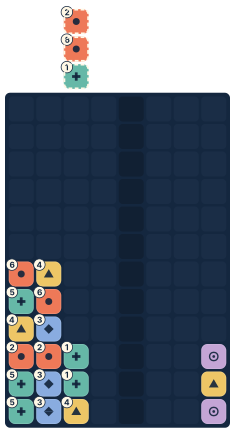
Build one column at a time from the edge, three cells at a time from the bottom. The number on a cell is the chain it clears in. The dashed triad above is the last piece, and the dark column is where pieces appear. The colors are one example: what to remember is the frame, one column clear in each column and a height equal to the chain. The numbers in a name count the column clears and the row or diagonal clears in the set that repeats.
Order of clears: column → row → column → diagonal → column → row. A column then a row or diagonal, repeated three times. Two triads (6 rows) in each column.
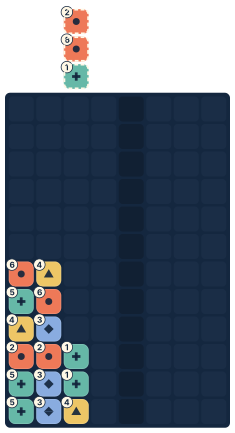
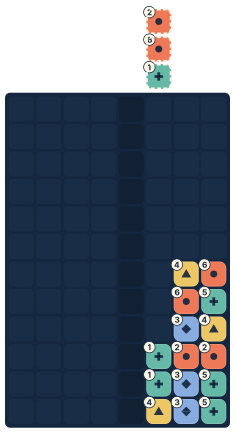
Order of clears: diagonal → column → diagonal → diagonal → column → row → diagonal → column → row. A row or diagonal, a column, then a row or diagonal, repeated three times. Three triads (9 rows) in each column.
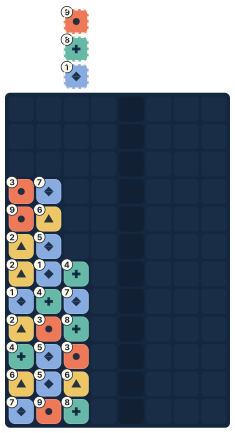
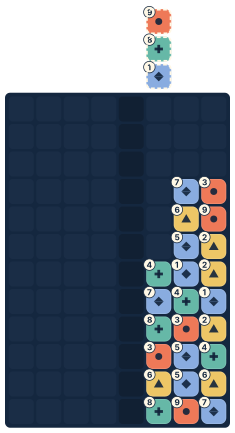
Order of clears: diagonal → diagonal → column → diagonal → diagonal → diagonal → column → row → diagonal → row → column → row. Two rows or diagonals, a column, then a row or diagonal, repeated three times. Four triads (12 rows) in each column.
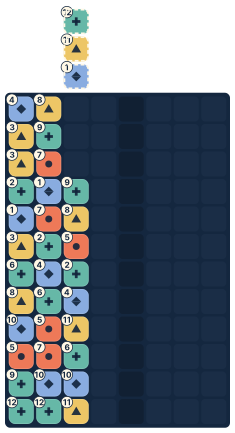
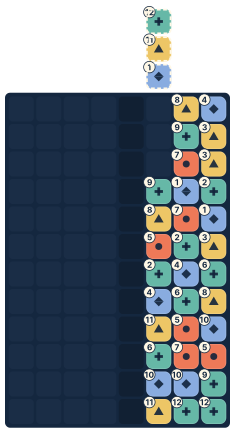
Openings that change a column's height or leave a triad unused.
Order of clears: row → column → row → column → row. Only one triad in the edge column; it starts with a row and alternates with columns.
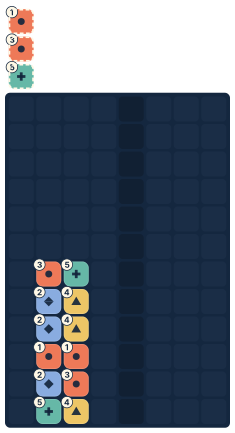
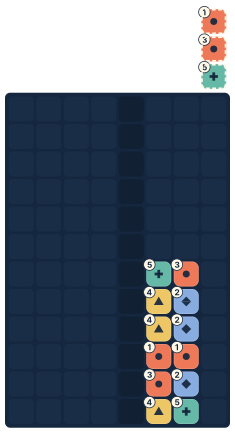
Order of clears: column → row → column → diagonal → column → column → row. One column holds three triads and clears vertically in the 5th and the 6th chain, one after the other (drop three, then a column).
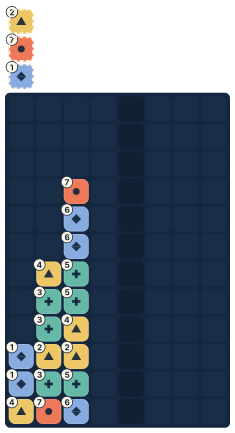
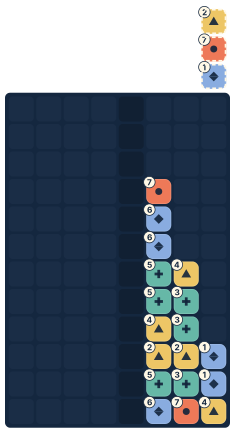
Order of clears: column → row → column → diagonal → column → row. The same clears as the 1 vertical, 1 row/diagonal 6-chain, with an unused triad left at the far edge. Three blocks remain.
Pieces appear at the top of the fifth column from the left. If a block is left at the top of that column when clears and chains end, the game is over. In the diagrams, that column is the dark one.
Left forms use the three columns at the left edge, leaving one column between them and the spawn column. Right forms use the three columns at the right edge, right next to the spawn column. Neither builds in the spawn column.
Play a form in the Chain Museum Solve RENSA Puzzles Start with the tutorial